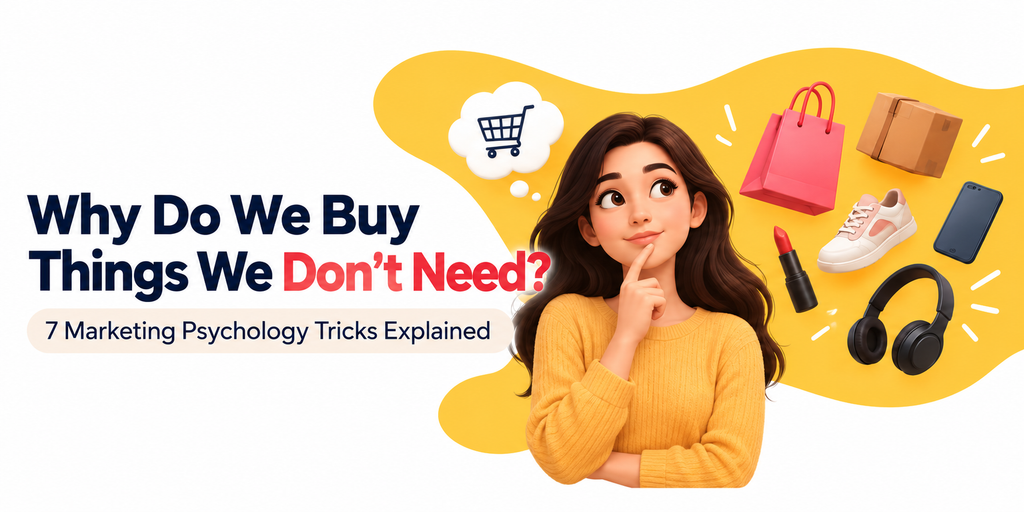
Have you ever gone to the website of Amazon / Flipkart and ended up buying 5 products instead of the 1 you intended to purchase?
Maybe you were looking to buy a phone charger but you also ended up buying a phone case, headphones and something you didn’t plan to buy.
Or maybe you were browsing through your Instagram feed, saw an attractive advertisement and wanted to order the product.
You didn’t plan to shop but somehow you ended up buying the product.
Why do we buy things we don’t need?
Why are we compelled to make these unplanned purchases even when we are trying to save money?
The answer lies in consumer psychology and marketing psychology.
Companies often use psychological marketing strategies to influence and change the way customers think, behave and make buying decisions.
From limited time discounts and attractive prices to customer reviews and emotional advertisements, marketing psychology can play tricks on the mind to make you want to purchase a product.
Let’s explore 7 marketing psychology tricks that influence our buying behaviour.
What Is Consumer Psychology in Marketing?
Consumer psychology studies how a person’s thoughts, emotions and behaviour influence their buying decision.
In digital marketing, businesses use consumer psychology to analyse how a customer thinks about buying a product, trusts and selects the brand and responds to an advertisement.
For example, you might see two water bottles that have a similar design.
But, whereas one water bottle costs ₹199, the other costs ₹999.
You might instinctively feel that the second water bottle is more expensive simply by looking at the price.
Psychological factors can influence our perception of a product.
Marketing psychology seeks to understand and explain why customers may feel compelled to make a specific decision such as purchasing a product based on these mental and emotional triggers.
Now, not all psychological marketing tricks are inherently manipulative.
Many tricks of marketing psychology help companies communicate the value of a product and help customers make better purchasing decisions.
But some companies use psychological marketing techniques to prey on our subconscious and influence us to make buying decisions that we wouldn’t otherwise make.
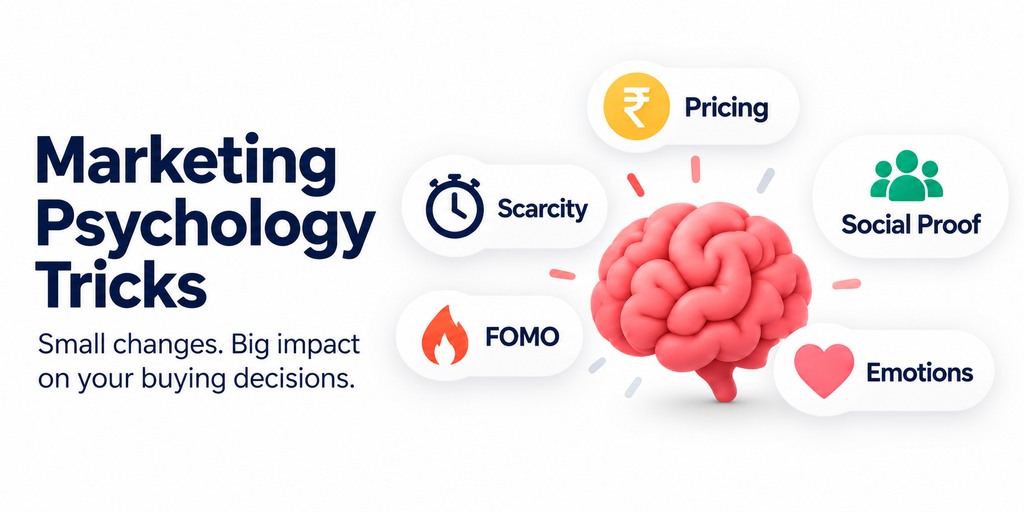
7 Marketing Psychology Tricks That Influence Our Buying Decisions
1. Psychological Pricing : ₹999 Appears Cheaper Than ₹1,000
Imagine shopping for shoes online and seeing that a pair costs ₹1,000.
You’re about to move on to the next page when you see another similar pair of shoes for ₹999.
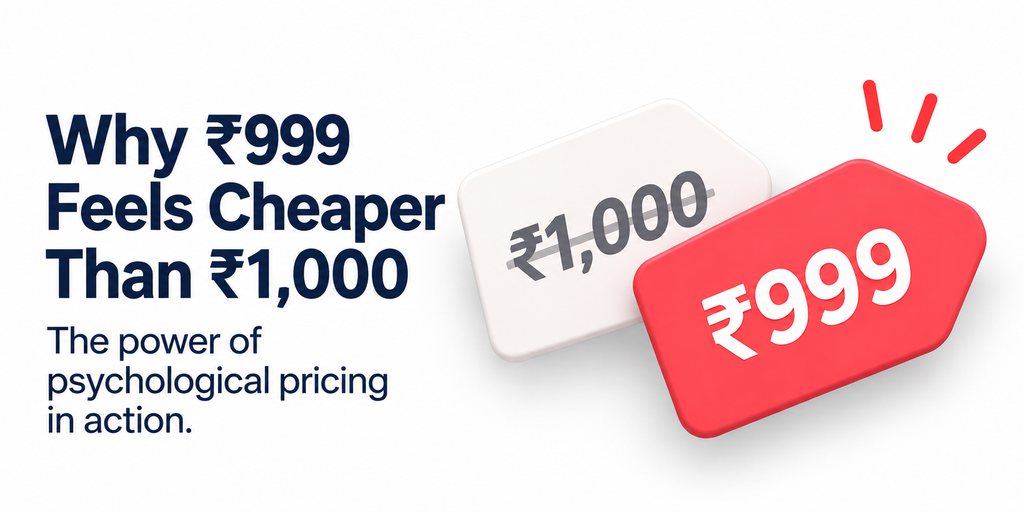
Even though the 2nd pair of shoes only costs ₹1 less than the 1st pair, you might feel that the 2nd pair is significantly cheaper.
This is an example of psychological pricing, a marketing trick that uses psychology to influence how the price of a product is perceived by the consumer.
One common type of psychological pricing is charm pricing.
With charm pricing, the price of the product ends in an odd number, such as:
- ₹499 instead of ₹500
- ₹999 instead of ₹1,000
- ₹1,999 instead of ₹2,000
Why does this work?
A possible explanation for this marketing trick is the left digit effect.
Since we read prices from left to right, the leftmost digit has the most weight.
This means that ₹999 appears significantly cheaper than ₹1,000 even though it only differs by ₹1.
Businesses use psychological pricing and charm pricing to influence the perception of value and incentivise purchasing decisions.
What can you learn from this?
Always compare the actual value and cost of a product instead of focusing on how “inexpensive” the price appears.
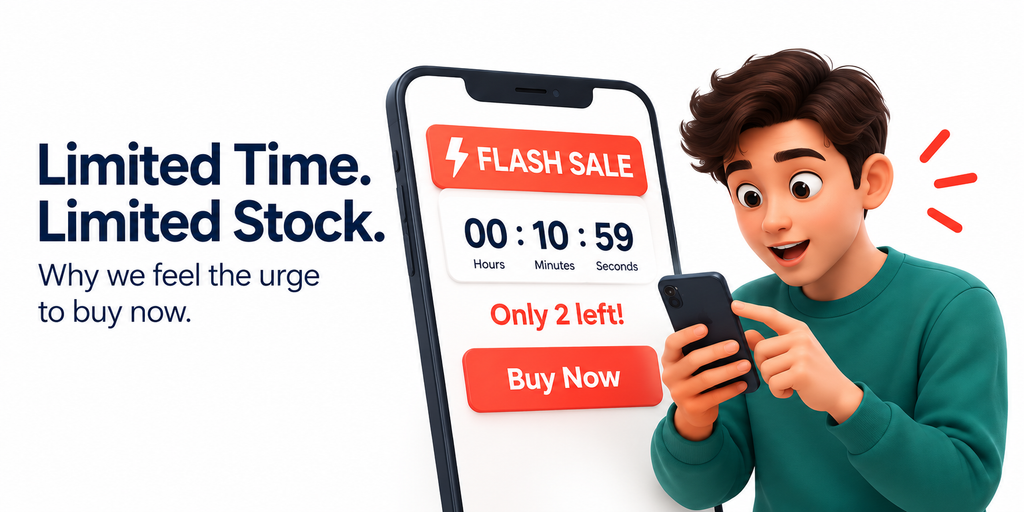
2. Scarcity Marketing, Scarcity Effect: We Want What We Can’t Have
While shopping on Amazon, have you ever seen messages stating: Only 2 items left! , Limited Edition! , Almost sold out!
Suddenly, a product you didn’t plan to buy seems essential.
You start to think that if you don’t buy this product now, you will regret missing out on an amazing deal.
This is the scarcity effect in marketing.
The scarcity effect is a psychological phenomenon where people desire things more if their availability is limited or if there is an expectation of scarcity.
Scarcity marketing is when businesses use this psychological trick to influence consumers to make a purchase decision.
When a consumer sees a product has limited supply or will be unavailable soon, they feel an urge to purchase it so that they don’t miss out.
For example, limited edition products are a common application of scarcity marketing.
Companies intentionally limit the availability of a product to make it more desirable.
While scarce products can create a sense of value and exclusivity, it’s important to recognise that limited supply doesn’t always indicate quality.
Sometimes businesses utilise deceptive scarcity to manipulate customers into making a purchase.
What can you learn from this?
Before buying any limited edition product, consider whether you would want to buy this product if it weren’t scarce.
3. Social Proof, Customer Reviews: We Believe What Other People Say
Imagine searching for a restaurant on Google and seeing 2 restaurants with similar menu items and prices.
Whereas one restaurant has 15 reviews, the other has 2,000 positive reviews.
Which restaurant would you choose to dine at?
Most people would prefer to dine at the restaurant with the 2,000 positive reviews.
This is an example of social proof.
Social proof is a psychological phenomenon where people make decisions based on the actions or opinions of others.
In marketing, social proof marketing is a technique that utilises customer testimonials, reviews and ratings to influence buying behaviour.
For example, if you’re considering buying a new skincare product, you’re more likely to purchase it if the product has a high rating and many positive reviews.
Common examples of social proof in marketing include:
- Customer reviews
- Testimonials
- Influencer marketing
- Customer success stories
- Bestseller badges
While products with positive customer reviews might indicate a higher level of satisfaction, it’s important to remember that popularity doesn’t always equate to the best option.
What can you learn from this?
Always read and compare customer reviews before making a purchasing decision.
4. FOMO Marketing, Scarcity Marketing: “Limited Time Offer!
Imagine browsing through an online clothing store and finding a jacket that you like.
But, you aren’t sure if you want to buy it.
Just as you’re about to leave the page, a popup ad appears at the top of your screen that says:”Sale ends in 10 minutes!”
A countdown timer also starts at the top of the page.
All of a sudden, instead of thinking about whether you want the jacket, you’re thinking about whether you’ll regret leaving the page.
This is an example of FOMO (fear of missing out) marketing, where businesses use urgency to influence customers’ buying behaviour.
FOMO marketing tactics often use countdown timers or special promotions (such as early bird offers) to create a false sense that a product is going to be unavailable soon.
Scarcity marketing and FOMO marketing are closely related, as both psychological marketing tricks utilise the psychological phenomenon of scarcity.
While limited time offers can be a great way to purchase a product at a discounted price, it’s important to remember that these marketing tactics are designed to encourage impulsive buying behaviour.
What can you learn from this?
Remember that a limited time offer isn’t a reason to buy anything.
Any product is only a worthwhile purchase if it has value to you.
5. Anchoring: The First Price Is Always The Most Expensive
Imagine browsing through an online electronics store and finding a smartwatch with the following pricing details:
Original price: ₹4,999
Sale price: ₹2,499
You feel happy that you can buy the smartwatch for almost half of the original price.
But, what if most similar smartwatches normally cost around ₹2,500?
This means that you’re only saving ₹1 from the original price of ₹4,999.
This is an example of the anchoring effect in consumer psychology.
Anchoring is a cognitive bias that causes us to rely on readily available information (such as the first piece of information) when making decisions.
Anchoring is commonly used in pricing psychology to influence the perceived value of a product.
By comparing the original price to a discounted sale price, businesses can create the illusion that the sale price is a better deal, even if it’s not significantly cheaper than the average price.
Anchoring can be used in many areas of marketing, including:
- Original price vs. sale price
- Premium product bundles
- Subscription pricing
When a customer sees an expensive subscription plan first, they are more likely to perceive a cheaper plan as a better value option.
What can you learn from this?
Always consider a product’s actual market price and compare it to other similar products before making a purchase.
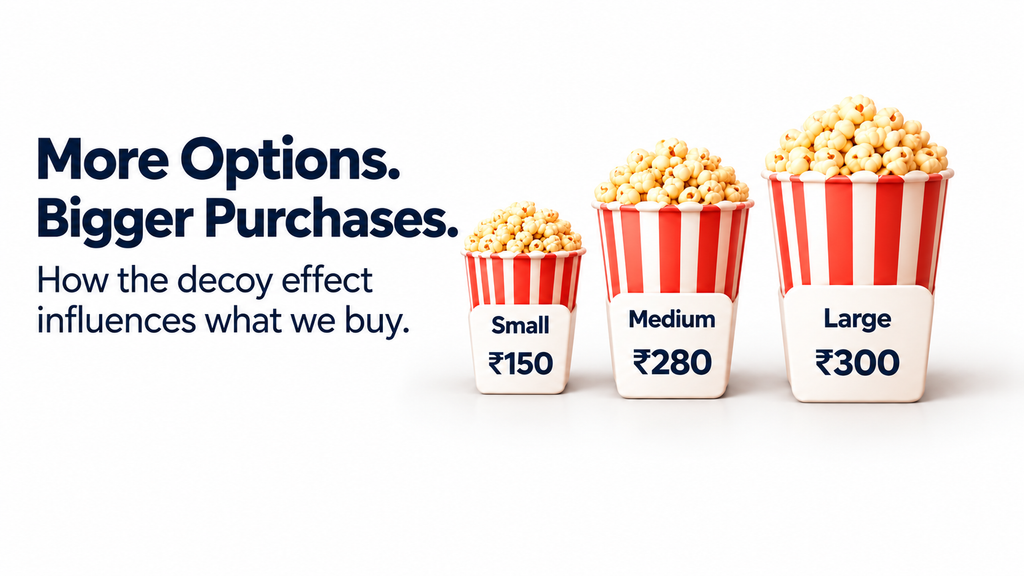
6. Decoy Effect: Why You Bought The Most Expensive Product
Imagine visiting a cinema and looking at the prices for popcorn.
Small popcorn: ₹150
Medium popcorn: ₹280
Large popcorn: ₹300
You were only planning to buy the small popcorn but now you’re wondering if you should buy the large popcorn instead of the medium popcorn.
The large popcorn only costs ₹20 more than the medium popcorn but it appears to be a much better deal.
This is an example of the decoy effect, where the introduction of a new option influences the way people make decisions.
The decoy effect is often used in pricing psychology to influence a customer’s buying behaviour by introducing a third, more expensive option.
Decoy pricing works by making one option (usually the most expensive option) appear to be a better value when compared to other options.
Decoy effect pricing is a common marketing psychology trick and can be used in various industries, including:
- Subscription plans
- Product bundles
- Restaurant menu pricing
While not all decoy pricing is manipulative, it’s important to understand how it can influence our buying behaviour.
What can you learn from this?
Always consider what features, quantity or services you need before comparing pricing options.
7. Emotional Marketing: We Buy Based On How We Feel
Think of your favourite advertisement.
Do you remember all of the features of the product?
Probably not.
But you might remember how the advertisement made you feel.
Perhaps it made you laugh or it reminded you of your childhood.
That’s the power of emotional marketing.
Emotional marketing capitalises on the fact that most of us don’t always make decisions based on logic.
Instead, we make decisions based on how we feel.
Emotional marketing is a marketing technique that taps into our emotions to influence our buying behaviour.
Instead of listing all of the features of a product, brands appeal to our senses by using music, relatable stories and visuals.
For example, chocolate advertisements use emotional branding by focusing on how the product makes us feel instead of describing the ingredients.
Clothing advertisements use emotional branding by appealing to our sense of confidence and individuality.
Emotional branding helps us form long lasting connections with brands and it helps customers remember the brand and its products.
Emotional marketing is a popular marketing tactic because it can help brands stand out from the competition.
However, it’s important to remember that emotional marketing isn’t always enough to convince us to buy a product.
The actual product quality, price and value still matter.
What can you learn from this?
Enjoy watching emotional advertisements but don’t forget to think about the actual benefits of the advertised product.
How Does Marketing Psychology Influence Consumer Buying Behaviour?
These 7 marketing psychology tricks influence our buying behaviour in different ways.
- Psychological pricing influences how we perceive the price of a product.
- Scarcity marketing and FOMO marketing create a sense of urgency to encourage impulsive purchases.
- Social proof influences our buying behaviour based on what other people say and do.
- Anchoring and decoy pricing influences what we perceive to be a good deal.
- Emotional marketing helps brands connect with us on a personal level.
Together, these 7 marketing psychology tricks can explain why we sometimes find ourselves buying products that we didn’t plan to buy.
However, it’s important to remember that our buying behaviour isn’t always influenced by these marketing psychology tricks.
Sometimes, we buy products based on our personal preferences and needs.
How to Avoid Impulse Buying and Make Smarter Shopping Decisions
By understanding consumer psychology and marketing psychology, we can now understand why we are influenced to make unplanned purchases.
Here are 5 practical ways to avoid buying things that we don’t need.
- Avoid buying things on impulse
- Compare prices and features of similar products
- Determine a shopping budget before browsing
- Read customer reviews before purchasing
- Be wary of limited time offers
These practical tips can help us avoid the marketing psychology tricks that influence our buying behaviour.
Conclusion
Next time you see an irresistible deal, limited edition products or viral recommendation. Ask yourself: Do I actually need this product or has the marketing made me feel like I do?
Understanding the tricks of marketing psychology and consumer buying behaviour can help us avoid mindless purchases. But it’s also important to remember that effective marketing isn’t always manipulative.
For businesses, understanding the psychology of customers is essential to help them communicate the value of their products and services to the public.
Ready To Understand Your Customers Better?
At Elwebee Digital Solutions, we help businesses connect with the right audience, gain visibility and help them turn customer interest into a meaningful business growth.
We do the marketing. You enjoy the growth.
Lets Grow Business Together!