
Developing a small business or startup is not easy.
You may spend most of your day improving your products, dealing with customers, keeping expenses under control and making sure your business runs smoothly.
But no matter how much effort is made, still one question remains the same:
How can I get more people to know about my small business and become customers?
Imagine running a small bakery.
Your cakes are amazing, your prices are affordable and your customers love what you do.
But only passers by walk in.
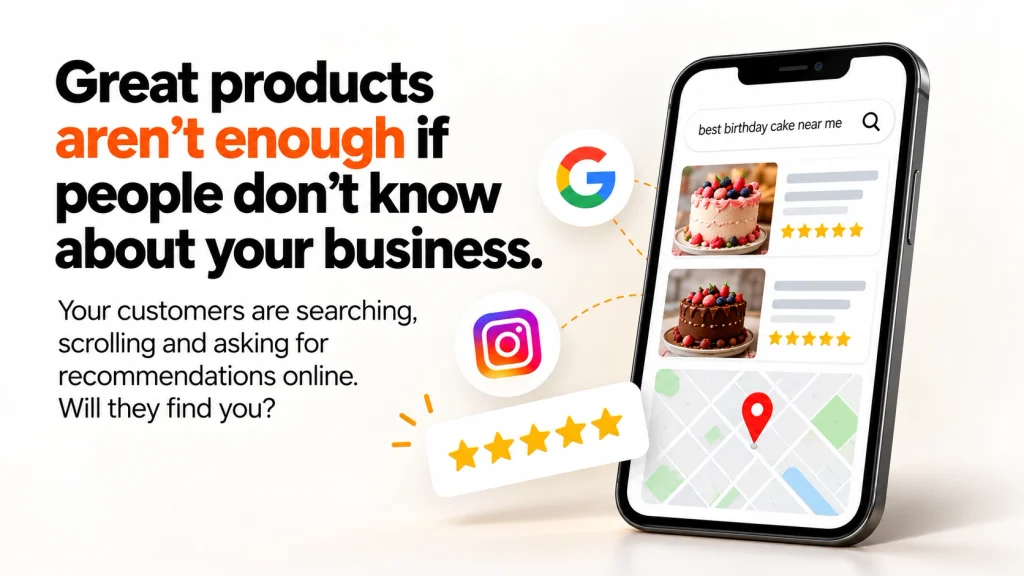
Now imagine someone Googling ‘best birthday cake near me’ or scrolling in Instagram looking for cake designs.
They are all potential customers but will any of them find your bakery?
That’s where digital marketing for small businesses comes in handy.
You don’t need a big marketing budget or a large marketing team to get started.
What do you need is an understanding of your customer, the right digital platforms and a marketing strategy that connects people interested in what your business offers.
In this guide, we will look at 10 digital marketing strategies for small businesses that can help you get more people to know about your business and become customers.
Why Is Digital Marketing Important for Small Businesses?
Think about the last time you dined in a restaurant, bought a product or hired a service professional.
What did you do before deciding on the place, item or person you chose?
You might search Google, Instagram or a review platform before making your decision.
Without solid digital marketing, you could be losing potential customers right at the discovery stage.
Here are some of the benefits of digital marketing for small businesses:
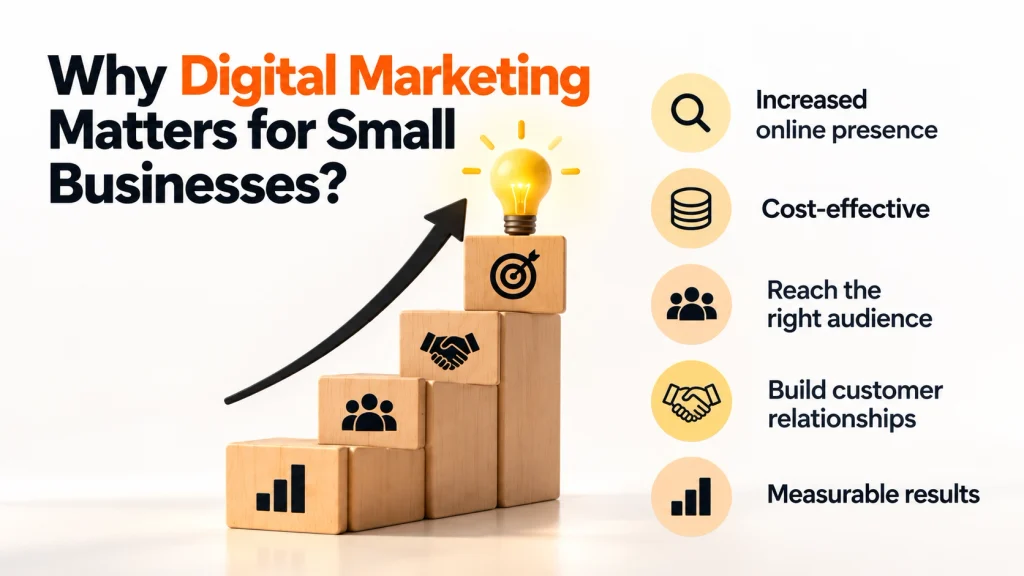
- Increased online presence: Ensure potential customers can find your products or services.
- Cost-Effective: It is often possible to start marketing on a small budget or even for free.
- Access to targeted audiences: Connect to people based on their needs, search intent or location.
- Building relationships: Maintain engagement with your customers.
- Measurable: You can track results, including enquiries, website visits, sales and other marketing related activities.
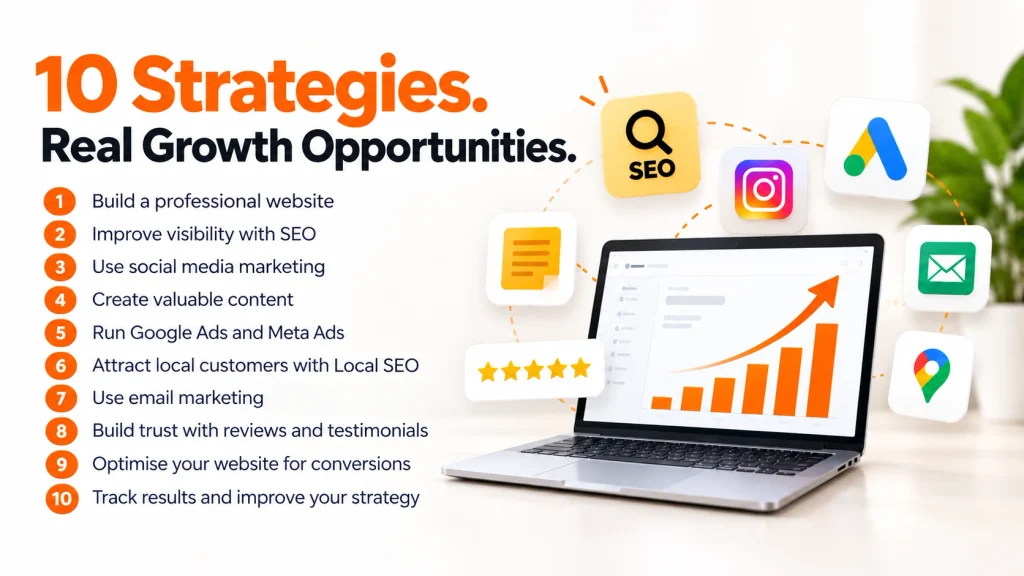
1. Build a Professional Website That Converts Visitors into Customers
Imagine visiting a website that loads slowly, displays unclear information and keeps you waiting.
Your website is often one of the first impressions potential customers will have of your business.
A good small business website should be able to immediately tell your visitors what you offer and what they can expect to do next.
How to achieve this:
- Use an aesthetically pleasing, professional and mobile-friendly website builder.
- Clearly describe your products or services.
- Make sure contact details are easy to find.
- Display testimonials and genuine customer reviews, if available.
- Add calls to action, such as ‘Get a Quote’, ‘Book Now’ or ‘Contact Us’.
- Improve the speed and navigation of your website.
For example, an interior design business with just photographs of beautiful rooms may find it harder to convert website visitors into customers than a similar business with clear information about the services offered, before-and-after photographs, frequently asked questions and a simple online consultation booking page.
2. Improve Your Online Visibility with Search Engine Optimisation (SEO)
Imagine someone Googling “best bridal makeup artist in Chennai” and finding your makeup artist’s website offering bridal services in Chennai.
But what if your website does not appear in the search results?
The person may instead see another makeup artist offering similar services and decide to hire them instead.
This is why SEO is an important digital marketing strategy for small businesses.
Search Engine Optimisation involves optimising your website to improve its visibility in search engine results.
Unlike paid advertising, SEO does not involve paying for every click.
However, it is a long-term digital marketing strategy that requires patience and hard work.
How to get started:
a. Research keywords related to your business.
b. Create informative web pages that answer frequently asked questions.
c. Optimise your web pages with relevant keywords.
d. Ensure your website is mobile-friendly and easy to navigate.
e. Add page titles and meta descriptions that accurately describe the content of the web page.
f. Publish informative content that answers common questions.
g. Use tools such as Google Search Console to monitor your progress.
For example, a fitness trainer could publish blog posts or videos on ‘beginner’s guide to exercise’ or ‘how to choose a personal trainer’.
3. Use Social Media Marketing to Connect with Your Audience
A common misconception among small businesses is that social media marketing is simply about creating and sharing content but posting regularly does not guarantee that your business will gain more customers, unless you know the right audience to post for.
If your business offers women’s clothing and regularly shares photos of outfits with captions such as ‘New collection is now available’, it will most likely receive fewer engagements and sales than a similar boutique that shares styling and outfit tips, customer reviews or behind-the-scenes content.
Practical social media marketing tips:
- Share educational content that helps your customers.
- Showcase your products and explain how they can solve common problems.
- Post short videos demonstrating your service or product.
- Share customer reviews with permission.
- Answer questions and engage with comments.
- Use calls to action when appropriate.
- Use the right platforms for your audience.
For example, Instagram is a great platform for fashion retailers, while LinkedIn is a good choice for business-to-business marketers.
4. Create Valuable Content That Attracts Potential Customers
Not everyone is prepared to buy a product or service the moment they search for it.
Sometimes, people are simply looking for information.
They may Google ‘how to choose an office chair’ but have no intention of buying anything straight away.
However, a furniture retailer’s comprehensive guide on how to choose an office chair has the opportunity to convert this prospective customer into a sale.
This is known as content marketing, creating valuable information that potential customers will find useful.
Content marketing for small businesses is a great way to educate your audience rather than focussing on selling your products and services.
Some ideas to get started:
- Blog posts answering common questions.
- How-to guides or tutorials.
- Product comparison guides.
- FAQs.
- Educational videos.
- Customer testimonials, reviews and success stories.
For example, a skincare business could create a beginner’s guide to skincare products, whereas a renovation company could publish a guide to renovation checklists.
5. Reach Potential Customers Faster with Google Ads and Meta Ads
While organic marketing is effective, it may sometimes take a lot of time and effort to get visible results.
Small businesses that need a faster way to make themselves known and attract customers can consider using paid advertising.
Google Ads and Meta Ads (formerly Facebook Ads) allow you to create advertisements targeting specific audiences.
For example, a newborn photography business could use Google Ads to target people searching for ‘newborn photographer’ and use Meta Ads to create engaging content introducing their services to the right people.
How to create effective Google Ads and Meta Ads:
- Set up a marketing objective.
- Define your target audience.
- Write compelling ad copy that appeals to your customer’s needs.
- Set a realistic budget for testing.
- Direct prospects to a relevant landing page.
- Track sales, enquiries and the cost per customer acquired.
However, it is important to thoroughly understand the cost effectiveness of each campaign, rather than simply chasing higher sales figures.
A Google Ads campaign with 10,000 views and 100 clicks may seem impressive but it will be a waste of money if none of the people who clicked actually enquired.
6. Attract Nearby Customers with Local SEO and Google Business Profile
If you own a restaurant, a salon, a dental clinic, a mobile mechanic or any other locally based business, local SEO and Google Business Profile can help you get found by nearby customers.
Imagine someone searching for “car repair near me” and seeing the Google Business Profile of a nearby car repair shop.
A solid local SEO strategy can ensure eligible businesses appear in Google Search and Maps.
How to improve your local SEO:
- Create a Google Business Profile, if you don’t have one yet.
- Make sure your business name, address and contact information are accurate.
- Categorise your business correctly.
- Update your business hours regularly.
- Add high quality photographs of your business, products or services.
- Encourage customers to leave reviews.
- Respond to customer reviews professionally.
For example, a local salon with an up-to-date Google Business Profile and positive reviews will find it easier to attract nearby customers looking for services such as haircuts and manicures.
Google Business Profile is a free tool for eligible businesses.
7. Build Long-Term Customer Relationships Through Email Marketing
It’s not enough to simply attract new customers.
Small businesses must also remember to nurture their existing customers.
That’s where email marketing for small businesses comes into play.
Email marketing is a great way to connect with your customers and remind them of your products and services.
How to improve email marketing:
- Send a welcome email to new subscribers.
- Provide valuable information related to your business and customers.
- Announce new products or services.
- Send special offers to your email subscribers.
- Ask for product or service reviews.
- Reconnect with inactive email subscribers.
For example, a stationery online store could send out monthly emails featuring organisation and planning tips, along with special offers for new product launches.
The idea is not to persuade customers to make a purchase straight away but to keep them engaged and remind them of your business’s value.
8. Build Customer Trust with Online Reviews and Testimonials
Would you rather hire a wedding photographer with no online reviews or one with positive testimonials from past clients?
As a customer, you are likely to want to know what other people are saying about a business before making a purchase.
That’s why customer reviews and testimonials are such an important part of online reputation management for small businesses.
Positive online reviews can increase the credibility of a small business, putting it ahead of competitors with no reviews.
Ways to encourage customer reviews:
- Ask your customers for honest online reviews.
- Display customer testimonials and reviews on your website, with permission.
- Share customer success stories and reviews on your social media channels, where appropriate.
- Respond politely to negative reviews.
- Address customer concerns openly and honestly.
- Avoid buying fake reviews or encouraging customers to lie.
For example, a wedding photographer can showcase client testimonials and examples of past weddings on their website.
If a customer leaves a negative review, the photographer should politely respond and offer a solution, rather than deleting the review or ignoring it.
9. Turn Website Visitors into Customers with Conversion Rate Optimisation
Let’s say your business website gets 1,000 monthly visitors but only five people contact you.
But what if your website simply needs some improvements?
This is where website conversion rate optimisation or CRO, comes in handy.
CRO is the process of improving your website to convince more visitors to take action, such as contacting your business, making a purchase or subscribing to your newsletter.
How to optimise your website conversion rate:
- Write clear headlines that encourage people to take action.
- Make calls to action, such as buttons or links, stand out.
- Simplify enquiry and subscription forms.
- Display customer reviews and testimonials.
- Explain your quotation or pricing process, if applicable.
- Make your website mobile-friendly and fast.
- Address potential concerns and objections.
For example, many websites for accountants get plenty of visitors, but fail to collect any enquiries.
A clearer description of services, an easy-to-complete contact form and a CRO focused website may convince website visitors to take action.
10. Track Your Marketing Results and Improve Your Strategy
Ask yourself this important question: Are my marketing activities actually helping me get more customers or am I simply wasting time and money?
That is why digital marketing analytics are so important.
By analysing the results of your marketing efforts, you can understand what is working well and what is not.
Some key marketing data to track:
a. Website traffic: The number of people visiting your website.
b. Sources of traffic: The channels bringing visitors to your website.
c. Leads: The number of people enquiring about your products or services.
d. Conversion rate: The percentage of website visitors taking a desired action.
e. Customer acquisition cost: How much you spend to acquire one customer.
f. Revenue: The income generated by your marketing activities.
Google Analytics and Google Search Console are some of the tools you can use for marketing analytics.
Conclusion
Digital marketing for small businesses can be simple and effective.
You don’t have to use all 10 of the strategies mentioned above. Instead, focus on learning what works best for your business and continue to improve upon those tactics. It’s also essential to understand who your customers are and what they need and how to deliver products or services to them.
Remember, having a great product is not enough, you must ensure that the target audience knows about it and is interested in purchasing.

Ready to Grow Your Business?
Elwebee Digital Solutions can assist small businesses in connecting with their target audience, increasing online presence and maximizing marketing efforts.
We take care of the marketing, so you can grow your business. Let’s get started.
Let’s Grow Your Business
https://www.instagram.com/el_webee?dlrf=MXFuMjQzejZmcWt1MQ==