Most of the people nowadays dont buy your product or service only after seeing them, they make a purchase after they see your social media platforms, reels, posts, customer reviews and blogs and this has become normal in these days.
The marketing funnel doesnot only help in attracting a person to become a customer but also helps in the long-term retention of the customers. In this blog, you will have a clear understanding about marketing funnel and its 5 stages in digital marketing.
What is Marketing Funnel in Digital Marketing?
The Marketing Funnel is a framework which acts as a customer journey path where a person discovers a product or service to making them make their purchase.
Either its online or offline marketing, the goal of the marketing funnel is to give the right message to the right people at the right time.
Why Marketing Funnel is Important for Small Businesses?
The funnel helps the businesses in understanding where the customer is from, where they are lacking and what to fix to improve the conversion rate.
The funnel helps the business to move towards the business growth goal not relying on any luck or guesswork.
It helps in building the trust among the people which helps in converting them into a potential customer and it doesnt stop there itself, it helps in the retention of the potential customers.
In funnel, you can know in which stage of the customer journey your customers are stucking and help them move to the next stage.
Each stage of the marketing funnel makes both the business and the customer move towards the goal.
The 5 Stages of Marketing Funnel
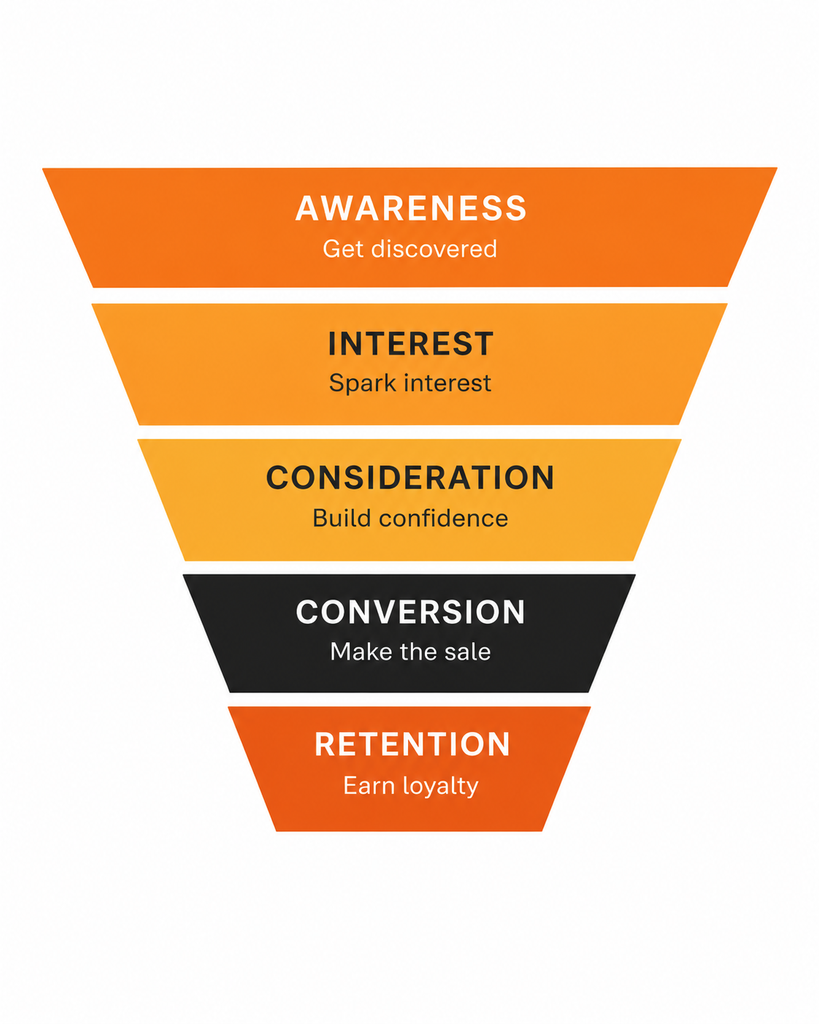
A marketing funnel can be divided into 5 customer journey stages. Some models can require only four or three stages. But adding the 5th stage is important if you are focusing on retaining your potential customers.
The marketing funnel becomes narrow at each stage.
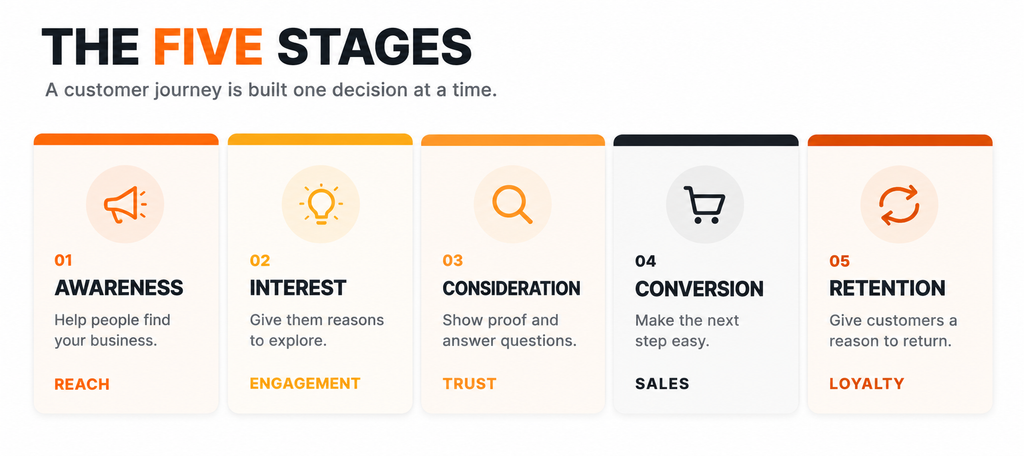
STAGE -1 : AWARENESS (BRAND AWARENESS)
At the top of the marketing funnel, people learn that your business exists. They may not identify that they have a particular need yet, so your role is to be found by them online, not to sell at this stage.
Customers may be thinking: “I have a problem but am unsure what to do about it.”
- Your goal: Reach the right people and build brand awareness and give them a good impression of your company.
- What works: SEO blog posts, reels, LinkedIn and Instagram posts, YouTube videos, Google and social media ads, local listings and word of mouth marketing.
STAGE – 2 : INTEREST (LEAD GENERATION)
People know you are there but start wanting more information and to engage with you. They start to follow your social media page, read a second article or social post or have joined your email or WhatsApp marketing list.
Customer may be thinking: “This seems helpful. Maybe they know what they are talking about.”
- Your goal: Attract attention and start cultivating customer interest by giving good information.
- What works: Lead magnets (free guides or checklists), email newsletters, content marketing, webinars and a welcome email or WhatsApp series.
STAGE – 3 : CONSIDERATION (LEAD NURTURING)
People are interested but now comparing their options in the buyer journey. They are serious about resolving their problem and want to choose wisely who can help them.
Customer may be thinking:”Are they a good fit for me? Are they better than the alternatives?”
- Your goal: Influence thinking and move them towards decision making, to build trust, brand credibility and show value.
- What works: Case studies, customer reviews, product demos, consultations, comparison pages, price transparency and a strong FAQ.
STAGE – 4 : CONVERSION (SALES CONVERSION)
People are making a decision to choose you over others. This is the point of sale and anything that confuses or puts off the prospect can cause them to walk away and lower your conversion rate.
Customers may be thinking:”I’m ready to go. How does it work, and is it safe?”
- Your goal: Facilitate the smoothest, easiest and safest transaction or purchase decision possible.
- What works: Clear offer, one strong call-to-action (CTA), easy discovery and booking, a guarantee or trial and answering any last objections.
STAGE – 5 : LOYALTY (CUSTOMER RETENTION)
Once the deal is done, the funnel doesn’t end. People who love what you do will become repeat customers and will spread the word to others and this can be the cheapest source of new customers through referral marketing.
Customers may be thinking:”Was this worth it? Would I recommend them?”
- Your goal: Deliver excellent value and customer experience to turn people into brand advocates.
- What works: Onboarding or thank you message, good support, WhatsApp or email reminders, loyalty rewards, review requests, and referrals discounts or rewards.
HOW TO BUILD A SIMLPLE MARKETING FUNNEL (STEP-BY-STEP)
We can build a marketing funnel in 7 simple steps and we don’t need fancy software to do it. Here’s how:
- Know who your ideal customer (target audience) is. Write down what they are like, what problems they have and where they spend their time online.
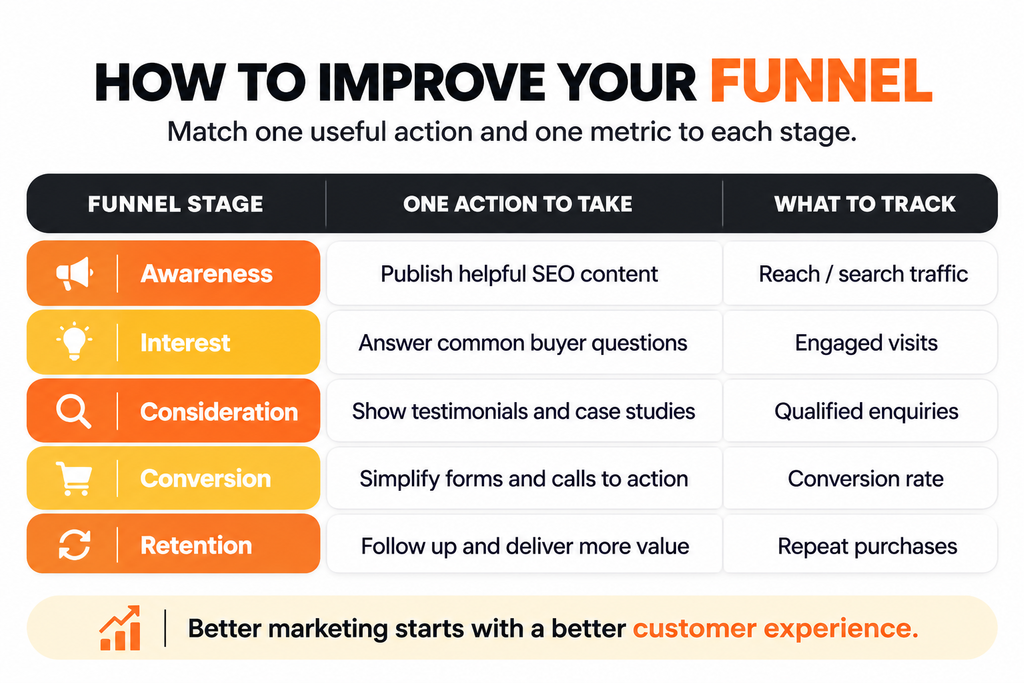
- Decide one clear marketing goal. For example, how many enquiries, bookings or sales leads you want to get per month. This will give you something to measure once you start.
- Know the buyer journey your customer will take. For each of the 5 stages, write down the questions they will have.
- Choose at least one marketing channel for each stage. It’s better to focus on 2 marketing channels per stage, rather than using 5 channels at once.
- Create one piece of content or lead generation offer per stage. For example, a reel for awareness, a lead magnet for interest, a case study for consideration, a clear offer for conversion.
- Capture leads and follow up. Get their email or WhatsApp number and send them helpful information, rather than leaving them hanging without lead nurturing.
- Measure and improve your funnel performance. Focus on improving one stage at a time, to reduce the funnel drop-off rate. Always look at why people are abandoning the marketing funnel and fix those issues first.
CONCLUSION:
A marketing funnel is a simple marketing concept , it represents a pathway that an individual who was previously unaware of your business will travel on their road to becoming a customer and promoter of your business.
The truth is, most of the customers won’t buy from you the first time they hear about your brand. They will go through a funnel, consuming your content in various shapes and sizes before they even consider buying something from you. A marketing funnel should be constructed in a way that it guides the customers through the 5 marketing funnel stages of Awareness, Interest, Evaluation, Conversion, and Loyalty.
To begin with, constructing a marketing funnel should be simple there is no need to invest in dozens of marketing tools and software. To build a simple marketing funnel, begin with defining your ideal customer and a specific business goal you want to achieve. Then, pick 1-2 marketing channels for each stage, capture the attention of your leads and prospects, convert them, and keep track of their progression through the funnel. Keep it simple: analyze the funnel drop-off point and rework the problematic segment of your funnel.
Remember, however, that a marketing funnel is not only a way to attract new customers and generate leads. There are more reasons why you may want to keep your loyal customers as promoters of your brand and business: a happy customer is a returning customer and a returning customer means business growth for you.
Is Your Marketing Funnel Turning Strangers Into Customers?
If people are finding your business but not enquiring, or enquiring but not buying, your funnel may have a gap.
At Elwebee Digital Solutions, we help businesses build a high-converting marketing funnel, from awareness to loyalty, that turns attention into enquiries and enquiries into customers.
Get in touch with Elwebee Digital Solutions to build a lead-generating marketing funnel around your business goals.